
Our guide walks through the official Tower Rush demo, every game feature we track, and the fake APK files, predictor claims and imitation websites that we flag for the Indian audience. Everything here is written in-house and checked against Galaxsys provider information before it goes live, so the figures we quote are the ones we have verified ourselves.
Play Tower Rush Online
Tower Rush turns a simple construction idea into a series of fast risk decisions. Every successful floor raises the active value shown on screen, and after each floor the same choice returns: secure that value, or build again and expose the whole attempt to a possible collapse. That loop is what gives the game its rhythm, and it stays easy to follow for anyone new to fast games as well as for those already familiar with the category.
Unlike a single-line crash game that plays out along one continuous curve, Tower Rush breaks the action into individual floors. Each floor is a clear decision point rather than a blur of movement, which keeps the game simple to understand while preserving the tension that makes fast games popular. Our How to Play guide covers the same loop step by step for anyone who wants a longer walkthrough.
We treat Tower Rush as a game of chance and we publish it that way. The value grows while floors keep landing, the tower can collapse on any build, and nothing about the interface, the timing or the tapping pattern changes the underlying maths. What follows is a full account of how we describe the game: the demo, the controls, the bonus floors, the risk lanes, the published RTP range and the safety guidance we attach to every session.
Start With the Free Tower Rush Demo
The demo runs on virtual credits, so the interface can be learned without a deposit. We point everyone to the free Tower Rush demo first: review the rules, set a simple virtual amount, build the first floor and check the new cumulative value before continuing. Repeating that a few times is the quickest way to understand how the Build and Cash Out controls behave and how quickly the displayed value moves.
Demo results remain random. A large virtual result is not proof of a strategy, and virtual credits cannot be withdrawn. We treat the demo as a place to learn the controls and confirm the current rules, not as evidence that any pattern or system works. Anyone who tells the Indian audience otherwise is selling something that does not exist.
The demo also gives a clean look at the version in front of the viewer. RTP configurations, trap settings and the list of bonus features can differ between builds, so the information panel inside the demo is the reliable source for the exact numbers. We quote the published Galaxsys range of 96.2% to 97.6% throughout Tower Rush, and we always add the same reminder: the panel in the session is the figure that applies.
Tower Rush on Mobile and Desktop Browsers
Tower Rush is browser based, so the game opens on Android phones, iPhones, tablets, laptops and desktop computers without a separate app. The layout adapts to the screen: on mobile the Build and Cash Out controls stay close to the tower so they sit within thumb reach, while on desktop there is more room for the history panel and the settings menu.
A stable connection helps the game feel responsive, but it does not change the underlying maths and it cannot make a floor more likely to succeed. Connection quality affects smoothness, not probability. We say the same about device age, screen size and browser choice: none of them move the odds in any direction.
Because everything runs in the browser, switching between a phone and a laptop mid-session sends nothing across in terms of progress. Each attempt starts fresh, and the tower that was built on one device has no effect on the next attempt anywhere. We describe that plainly so nobody reads a false advantage into moving between screens.
Tower Rush Game Rules at a Glance
| Game Feature | Details |
|---|---|
| Game name | Tower Rush |
| Provider | Galaxsys |
| Release date | 28 February 2024 |
| Game category | Fast game, turbo game and tower multiplier game |
| Official RTP | 96.2% to 97.6% |
| Main objective | Build floors and secure the cumulative value before a collapse |
| Bonus features | Frozen Floor, Temple Floor and Triple Build |
| Risk controls | Selectable trap or difficulty settings in supported versions |
| Tower height | No fixed maximum floor limit stated by Galaxsys |
| Fairness | RNG technology and provable fairness |
| Demo availability | Mobile and desktop browsers |
| Separate download | Not required for the official demo |
| Minimum age | 18+ |
We check the in-game information panel against these figures and note any change, because RTP configurations and displayed values can differ between versions. The numbers that matter at any moment are the ones shown in the session that is actually running, which is the figure we always return to.
Why Tower Rush Stands Out
A Simple Build or Cash Out Decision
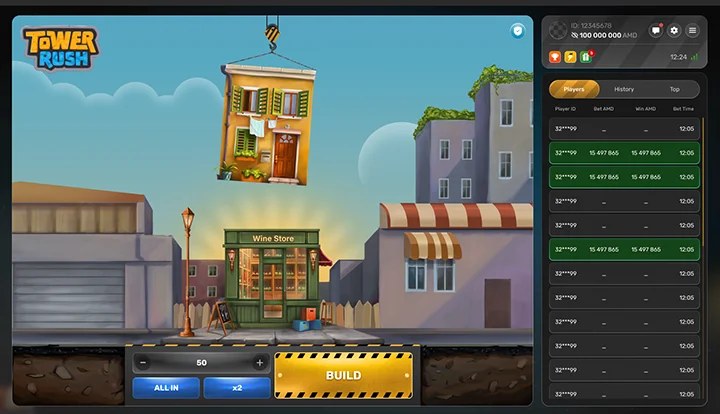
There are no symbols or paylines to memorise. Build attempts another level, and Cash Out secures the value currently displayed. The decision itself grows heavier as the tower grows taller, because there is more accumulated value to protect with every extra floor, and that rising weight is the whole tension of the game.
Three Distinctive Bonus Floors
Frozen Floor, Temple Floor and Triple Build add variety to a run. They are part of the random system, which means they cannot be triggered by tapping speed, a secret pattern, the amount chosen or the time of day. When they appear, they appear because the game system produced them, not because of anything done at the screen to force them.
Selectable Risk in Supported Versions
Trap or difficulty settings create different volatility lanes. A lower-risk setting tends to give steadier, smaller increases, while a higher-risk setting produces fewer successful placements but larger changes when they land. Changing the setting adjusts the shape of the experience; it does not remove the house margin and it does not predict results.
Short, Mobile-Friendly Rounds
Rounds are fast, which suits mobile play, but that speed is exactly why personal limits matter. Because decisions come quickly, it is easy to play more rounds than intended, so we recommend a session timer set before the first build and treated as a firm boundary throughout.
Tower Rush Game Guide - Learn the Basics
Four ideas carry the whole game, and we keep them at the front of our guide because everything else is built on top of them. Read them together and the rest of the page follows naturally.
Build the First Floor
Every run starts by placing the first floor. This confirms the amount for the attempt and sets the base of the tower that is about to be built. Nothing in the game happens until that first floor is placed, so the very first decision frames everything that follows.
Watch the Cumulative Value Increase
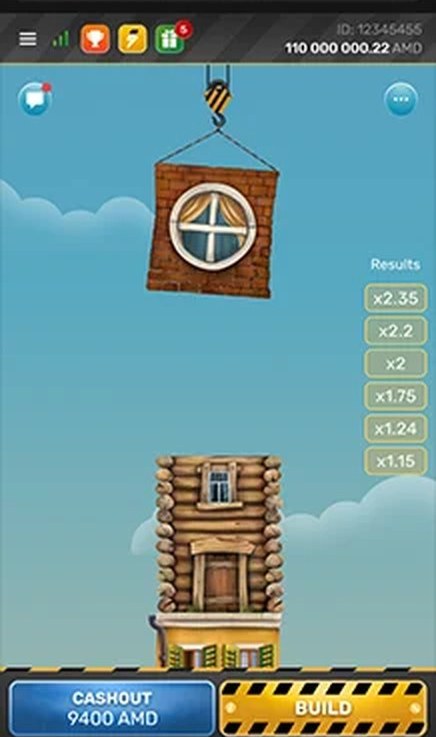
Successful floors multiply the value; they do not add to it. For example, a floor at 1.40 followed by a floor at 1.50 produces roughly 2.10 rather than 2.90, because the values are multiplied together rather than summed. The exact figures depend on the configuration of the version in play, so the numbers shown in the running session are the ones to read.
Choose Whether to Continue
A stopping point decided in advance does most of the work. The height of the tower records how many floors have already succeeded, but it does not make the next floor any safer. Each new floor is judged on its own, regardless of how tall the structure has become, and that independence is the single most misunderstood part of the game.
End the Attempt Before a Collapse
Cash Out ends the chain at the value on display and secures it. If the structure collapses before it is secured, the sequence ends with nothing from that run. Bonus protection, where the rules provide it, can change what happens on a given floor, but it is not unlimited safety and it should not be read as a guarantee. For a fuller walkthrough, follow the How to Play steps.
Play Tower Rush in Six Steps
- 1Open the official demo. Start from the verified Galaxsys demo rather than an advert or a forwarded link. We ask everyone to confirm the domain before playing and to avoid pop-up ads and shortened links that claim to offer a special version.
- 2Read the current information panel. Check the RTP, the available risk or trap settings and the bonus features listed for the version in front of the screen. These details can vary, so the panel is the reliable source.
- 3Choose a virtual amount. Pick a simple, easy-to-follow amount for the first floors so the change in the cumulative value after each build is clear to see.
- 4Select a risk setting. Start on the lowest trap or difficulty setting while learning. A lower setting gives steadier progression and makes the loop easier to read.
- 5Build or Cash Out. Press Build to add a floor, then pause and read the new value before deciding again. Cash Out secures the displayed value whenever another floor feels like a risk too far.
- 6Review the result. Look at how many floors were completed and whether a bonus floor appeared. Use the demo to learn the mechanics, not to hunt for patterns that do not exist.
Explore the Three Tower Rush Bonus Floors
The three named bonus features are part of what separates Tower Rush from a plain multiplier ladder. We describe each one below and, in every case, return to the panel that describes the exact calculation for the version in play.
Frozen Floor
Frozen Floor is protection themed. It may preserve an active value on a run, but the exact protection depends on the current rules, so the panel is where the real description sits. When it appears, the value being protected has to be weighed against the exposure that continuing would add. Frozen Floor does not reveal the next result.
Temple Floor
Temple Floor is a segmented-wheel style bonus event that may add a value or a modifier. The segments on the wheel are not necessarily equal in probability, because digital wheels can weight segments behind the scenes. Tapping the screen cannot force a particular segment to land.
Triple Build
Triple Build adds three floors in one sequence, which produces a faster visual jump up the tower. Three visual floors do not necessarily mean a x3 outcome, because the result depends on the rules in force. The displayed value after the sequence completes is the figure to review, rather than any assumption of a fixed multiplier.
Tower Rush Risk Lanes Explained
Where a version offers trap or difficulty settings, they behave like lanes of volatility rather than difficulty levels to beat. We describe the three common shapes below, and in each case the lane changes how the run feels without changing the long-run margin built into the game.
One Trap: Steadier Progression
A single-trap setting tends to move in smaller, steadier steps. Steadier is not the same as safe, and the house margin still applies to every floor that is built regardless of the lane selected.
Two Traps: Balanced but Sharper
A two-trap setting sits in the middle, with sharper swings than a single trap. Balanced describes how it feels rather than a promise of a mathematically neutral outcome, and the margin applies here just as it does everywhere else.
Three Traps: High Volatility
A three-trap setting is high volatility, and it is the setting most likely to encourage loss-chasing. Random results do not compensate for previous losses, so we advise against combining a high-risk setting with an increase in amount after each collapse.
Tower Rush Probability and Cumulative Success
Probability falls rapidly when several floors all have to succeed in a row. The table below uses a simplified model with three equally weighted positions. It is illustrative only and does not represent the exact configuration of any specific version, but it shows why long runs become unlikely as the tower climbs.
| Floors and Traps | Illustrative Success Per Floor | Cumulative Success |
|---|---|---|
| 1 floor with 1 trap | 66.6% | 66.6% |
| 2 floors with 1 trap | 66.6% | 44.4% |
| 3 floors with 1 trap | 66.6% | 29.6% |
| 5 floors with 1 trap | 66.6% | 13.2% |
| 1 floor with 2 traps | 33.3% | 33.3% |
| 2 floors with 2 traps | 33.3% | 11.1% |
| 3 floors with 2 traps | 33.3% | 3.7% |

Why Cumulative Success Declines
Each additional floor multiplies another below-certainty chance onto the run. Because probabilities that are each less than one are being multiplied together, the combined chance of completing every floor drops sharply as the tower gets taller, even when the per-floor chance looks reasonable on its own.
Do Previous Floors Affect the Next One?
No. Expecting a collapse because several floors have succeeded, and expecting more success because of a recent collapse, are two versions of the same gambler's fallacy. Random results do not remember what came before, so past floors do not shift the odds of the next one in either direction.
Tower Rush RTP Explained
Galaxsys publishes an RTP for Tower Rush in the range of 96.2% to 97.6%. RTP, or return to player, is a theoretical long-run percentage measured across a very large number of rounds, not a figure that applies to a single session. We quote the range because the exact value depends on the configuration of the version in front of the viewer.
RTP Is Not a Personal Return
An RTP of about 97% does not mean that every ₹100 returns ₹97. It is a long-term average across all rounds played by everyone, and any individual session can land well above or well below it. We separate the two ideas because conflating them is the most common source of confusion in fast games.
Understanding the House Margin
The house margin is the part of the RTP that is not returned over the long run. An RTP of 97.6% leaves a margin of about 2.4%, and an RTP of 96.2% leaves a margin of about 3.8%. This margin is built into the maths of the game rather than charged as a visible fee, which is why it never appears as a line item on any statement.
Why the Game Panel Matters
The same title can be configured with different RTP values across different online casinos and versions, so the number in the game panel is the one that matters. We always confirm it there rather than relying on any figure quoted elsewhere.
Tower Rush RNG and Provably Fair Results
Random Number Generator
Results are produced by a random number generator. Tapping speed, phone model, connection and where the screen is touched do not control the values that appear. A history panel can show what already happened, but it cannot reveal the next hidden result.
Provably Fair Verification
Provable fairness uses cryptographic hashes, seeds and a nonce so that results can be checked after a round. Where a version offers this, the current fairness panel describes the exact steps, because the method can differ between versions.
Verification Is Not Prediction
A verifier examines completed results to confirm they were not altered. A predictor claims to know a result before it happens. These are fundamentally different things, and provable fairness does not remove the house margin or make outcomes foreseeable.
Tower Rush Demo Versus Real Money
| Feature | Tower Rush Demo | Real-Money Mode |
|---|---|---|
| Balance | Virtual credits | Actual deposited funds |
| Financial risk | None | Deposited money can be lost |
| Registration | Generally unnecessary through the official demo | Platform account and verification may be required |
| Withdrawals | Not available | Dependent on platform and applicable law |
| Main purpose | Learning controls and game features | Wagering with financial consequences |
| Best use | Interface practice and rule verification | Not recommended where online money gaming is prohibited |
What the Demo Teaches
The demo is ideal for learning the controls, seeing how the cumulative value builds and confirming which bonus floors and settings a version includes. The Build and Cash Out loop can be practised with no financial pressure, which is exactly what we want for a first encounter with the game.
What the Demo Cannot Teach
The demo cannot teach a winning system, because there is no such system to learn. It cannot predict future results, and a strong run on virtual credits carries no advantage into any other mode of play.
Real-Money Access in India
India's Promotion and Regulation of Online Gaming Act, 2025 prohibits offering or participating in online money games, advertising them and facilitating related fund transfers. An offshore licence, an INR balance or a UPI option does not override Indian law. We therefore steer the Indian audience to the free demo and to our responsible gambling guidance rather than to real-money play.
Tower Rush Mobile App and Download
No Separate Tower Rush App Is Required
The official demo runs in a browser, so there is no separate Tower Rush app to download. Opening the game in a mobile or desktop browser is enough to try it, and that keeps the risk surface small for the whole audience.
Android and iPhone Compatibility
Because it is browser based, the game works across Android phones and iPhones as well as tablets and computers. Nothing has to be installed to reach the demo, and no package needs to be kept up to date.
Tower Rush APK Warning
Anybody can build an Android package and copy a logo, so a file that looks official may not be. We advise avoiding modified, unlimited-money or predictor apps. These files may request access to SMS, contacts, photos, notifications or accessibility controls that a simple game has no reason to need. An APK arriving through Telegram, WhatsApp, a shortened link or an unknown app directory should never be installed.
Tower Rush Earn Money APK Claims
Tower Rush is not a legitimate employment or investment product. Apps that promise earnings often show fake balances and simulated withdrawals, then introduce activation, tax, identity or upgrade fee traps to extract money. We treat Tower Rush as a game of chance, never as a source of income.
Is Tower Rush Real or Fake?
The original Galaxsys product is real. The ecosystem that has grown around it, however, can include fake apps, cloned sites, predictor groups and misleading earning claims. Our honest answer is that the game is genuine while many things using its name are not, and separating the two is the purpose of this section.
How to Verify the Original Tower Rush
Start from the Galaxsys provider information and the game's own panel, which lists the release date, the RTP range and the bonus features. Matching what appears on screen against those official details is more reliable than trusting screenshots or forwarded links.
How Fake Websites Look Convincing
Cloned sites copy the logo, borrow licence numbers that belong to another company and add countdown timers or other pressure tactics. A polished appearance is not proof of legitimacy, and we treat visual quality as no evidence at all.
No Tower Rush predictor can guarantee the next floor, bonus or collapse. Sellers highlight the calls that happen to be correct and quietly delete the failures. Signal-group admins send different predictions to different groups so that at least one looks right, and premium payments give no control over the RNG. We flag fake withdrawal fees that ask for money before a promised payout that never arrives.
Tower Rush Play Styles and Session Rules
Play styles are about discipline rather than tactics, because no tactic changes a random result. What a style can do is decide in advance when a session ends, which is the only lever that gives any control at all. We describe three common shapes below.
Turtle Style
Turtle style is the lowest-risk approach: keep the trap setting low and stop early, often in the region of 1.5x to 2.0x. No target is ever guaranteed, but stopping early reduces how much a single collapse can take from a run.
Moderate Style
Moderate style sets a fixed maximum number of Build decisions before the run starts and sticks to it. Deciding the cap in advance keeps the choice out of the heat of the moment, which is where judgement tends to slip.
Aggressive Style
Aggressive style uses a higher risk setting and aims for taller sequences, which brings the sharpest chasing pressure. Anyone playing this way benefits from a short, predetermined limit and from the reminder that near misses are not stored progress; a run that almost reached a floor counts for nothing on the next attempt.
| Session Style | Typical Target | Trap Setting | Stop Rule |
|---|---|---|---|
| Turtle | Early 1.5x to 2.0x range | 1 trap | Fixed session limit |
| Moderate | Mid-range progression | 1 or 2 traps | Predetermined floor cap |
| Aggressive | Taller, volatile bursts | 3 traps | Separate hard limit |
Tower Rush Multipliers: A Worked Example
Because floors multiply rather than add, a short worked example makes the maths clearer than any description. The figures below are illustrative and use round numbers, but they show the shape of a run and why the cumulative value climbs faster than the floor count suggests.
| Floor | Illustrative Floor Value | Cumulative Value After the Floor |
|---|---|---|
| Base | 1.00 | 1.00 |
| Floor 1 | 1.20 | 1.20 |
| Floor 2 | 1.30 | 1.56 |
| Floor 3 | 1.40 | 2.18 |
| Floor 4 | 1.25 | 2.73 |
| Floor 5 | 1.50 | 4.10 |
Two things stand out from the table. First, each floor applies its own value on top of everything already accumulated, so a single strong floor late in a run moves the total more than an early one. Second, a collapse at any point removes the entire cumulative figure, not just the last step, which is why the decision to Cash Out grows heavier with height.
We include the example because multiplication is where most confusion about fast multiplier games begins. Adding the floor values in the table above would produce roughly 7.65 after five floors if they were summed, but the true cumulative figure is closer to 4.10 because the values compound. Reading the displayed number rather than estimating it keeps the picture accurate.
Tower Rush Fairness and What We Check
Fairness in Tower Rush rests on the random number generator and, where offered, on provable fairness that lets a completed round be verified afterwards. We do not take a provider's word for the details; we read the published documentation and the in-version panel, and we report the range rather than pretending a single fixed number applies everywhere.
What a Fairness Panel Shows
A fairness panel typically shows the seeds and hashes associated with completed rounds so that the outcome can be recomputed. It is a record of what happened, not a window into what comes next, and we make that distinction explicit wherever the topic comes up.
What Fairness Does Not Promise
Fairness does not promise a profit, a return above the RTP range or an escape from the house margin. It confirms that the results were produced honestly according to the published rules; it says nothing about any individual session's outcome.
Tower Rush Payments and Currency in India
Payment handling is a platform topic rather than a game topic, but it matters to the Indian audience and we cover it directly on Tower Rush. Where any real-money surface is discussed, the rails that appear most often are UPI, IMPS, NEFT, Paytm, PhonePe and Google Pay, with cards present but less common.
| Method | Typical Deposit Speed | Typical Withdrawal Speed |
|---|---|---|
| UPI | Instant | 15 minutes to 4 hours |
| IMPS / NEFT | Instant to 30 minutes | 2 to 12 hours |
| Wallet (Paytm, PhonePe) | Instant | 1 to 8 hours |
| Debit or credit card | Instant | 1 to 3 working days |
| Manual bank review | 30 minutes to 2 hours | Up to 24 hours |
These ranges come from our own observation and from reports we collect, and they are not promises from any operator. A first withdrawal almost always takes longer because identity verification runs once, and any platform that forces a currency conversion on every deposit is quietly adding a second margin. We note that pattern wherever we see it.
Tower Rush Session Limits and Safer Play Tools
Fast games reward short sessions and clear boundaries. We recommend three tools that cost nothing and take seconds to set before the first build of any session, and we repeat them because they are the most useful habit in the whole category.
- Set a session timer before starting and stop when it ends, regardless of where the run stands.
- Fix a loss limit and a win limit in advance, and treat both as hard stops rather than suggestions.
- Keep play inside the free demo, which removes financial consequences from the session entirely.
If gambling stops being fun, help is available around the clock. Tele-MANAS can be reached on 14416 or 1-800-891-4416. Reaching out early is a strength, not a weakness, and no session is worth more than wellbeing.
Tower Rush Myths We Have Checked
A steady stream of claims circulates about Tower Rush, and we test each one against how the game actually works. None of the following survive a close look, and we list them so the Indian audience can recognise them quickly.
- A taller tower is safer. The tower records past floors; it does not change the next result.
- A recent collapse means a win is due. Results are unrelated, so a collapse makes nothing more likely.
- Tapping faster changes the outcome. The random number generator ignores input timing entirely.
- A predictor can call the next floor. No tool can forecast a random result before it happens.
- An earning app turns the game into income. It is a game of chance with a published margin below 100%.
- A bigger bet after a loss recovers money. Random results do not compensate for earlier outcomes.
Tower Rush Glossary for Fast Games
Fast games come with their own vocabulary, so we keep a short glossary on Tower Rush to make every other page easier to read. Each term is defined the way we use it across the site.
| Term | What It Means on Tower Rush |
|---|---|
| Build | Adding another floor and accepting the risk that the tower may collapse. |
| Cash Out | Ending the run at the displayed value and securing it. |
| Cumulative value | The combined multiplier after each successful floor, built by multiplication. |
| Trap setting | A volatility lane that changes how frequently floors succeed. |
| Bonus floor | One of Frozen Floor, Temple Floor or Triple Build appearing at random. |
| RTP | The published long-run return percentage, quoted here as 96.2% to 97.6%. |
| House margin | The part of the RTP not returned over the long run. |
| Provable fairness | A method that lets completed rounds be verified after the fact. |
| Volatility | How large and how frequent the swings in a session tend to be. |
Tower Rush and the 2026 Indian Gaming Framework
India's national framework treats online money gaming as prohibited, and it reaches the activity, the advertising and the movement of funds around it. We keep Tower Rush aligned with that position by steering the Indian audience to the free demo and by describing the rules in plain terms rather than hedging them.
Three points matter most to the Indian audience, and we repeat them on every page that touches real-money play. First, an offshore licence does not create a local right to play for money. Second, advertising an online money game and facilitating transfers connected to it fall inside the same prohibition. Third, winnings that may arise in any context can carry tax consequences, so a simple record of activity is worth keeping from the start.
State law adds a further layer, because games of chance for stakes are restricted in several Indian states and the position moves as legislation changes. Our platform reports the current state-level position rather than repeating a blanket claim, and we treat a restricted state as a reason to keep play inside the demo.
What this means for Tower Rush is simple. The game stays the same wherever it is shown, but the safest way to engage with it in India is the demo, where virtual credits carry no financial risk and no transfer of funds takes place at all. We describe the mechanics in full for exactly that audience, and we keep the real-money material at arm's length with the legal picture attached.
- Keep play inside the free demo, where no funds move and no financial risk exists.
- Treat an offshore licence as no substitute for a local right to play for money.
- Check the current position for a state before registering anywhere.
- Keep a running record of any deposits, withdrawals and winnings for tax purposes.
Tower Rush Versus Other Crash Games
| Feature | Tower Rush | Aviator | Balloon-Style Games |
|---|---|---|---|
| Main visual | Tower built floor by floor | Aircraft with rising curve | Expanding balloon |
| Decision rhythm | Separate Build or Cash Out choices | Continuous exit window | Continue or exit before burst |
| Bonus structure | Frozen, Temple and Triple Build | Depends on the selected title | Depends on the selected title |
| Tower Rush RTP | 96.2% to 97.6% | Check the current Aviator panel | Check the current product panel |
| Predictor reliability | No guaranteed predictor | No guaranteed predictor | No guaranteed predictor |
Tower Rush Versus Aviator
Aviator plays out on one continuous rising curve, with a single moment chosen to exit. Tower Rush replaces that continuous window with separate Build or Cash Out decisions, one per floor, which many find easier to pace because every step is a distinct choice rather than a reaction under a moving clock.
Tower Rush Versus Balloon Games
Balloon-style games inflate a balloon that can burst, with the choice at any moment being to continue or exit before it does. Tower Rush keeps the same continue-or-secure tension but frames it as a structure built upward, floor by floor, so the risk accumulates in visible steps rather than in a single swelling number.
What Makes Tower Rush Distinctive
The clearest distinction is the floor-by-floor structure, with its three named bonus floors and its published RTP range of 96.2% to 97.6%. As with every game in this category, no predictor is reliable, so the mechanics and the in-version panel are what we compare rather than any promised signal.
Tower Rush: Frequently Asked Questions
Who developed Tower Rush?
Galaxsys developed and publishes the original Tower Rush. Its official product page includes the release date, RTP range, bonus features and mobile and desktop demonstrations.
Is Tower Rush real or fake?
The Galaxsys game is real. Fake risks include cloned websites, modified APK files, predictor applications, edited winning videos and signal groups claiming guaranteed results.
What is the official Tower Rush RTP?
Galaxsys currently publishes an RTP range of 96.2% to 97.6%. The exact value should be confirmed in the information panel of the current version.
How do Tower Rush trap settings change?
Trap settings represent different volatility lanes in supported versions. A lower setting generally provides steadier progression, while a higher setting creates less frequent success and larger potential changes.
Can a Tower Rush demo be played?
Yes. Galaxsys provides official mobile and desktop demo routes. The demo uses virtual credits and allows the game to be learned without depositing money.
Does Tower Rush require an app?
No separate application is required for the official browser demo. It can be accessed on Android phones, iPhones, tablets and desktop computers.
Do Tower Rush predictors work?
No predictor can guarantee the next result. RNG outcomes cannot be forecast through tapping patterns, previous rounds, Telegram signals or modified APK files.
What are the Tower Rush bonus floors?
The three named bonus features are Frozen Floor, Temple Floor and Triple Build. Their exact effects and calculations should be checked through the current game rules.
Can Tower Rush be played for real money in India?
India's national online gaming legislation in force from 2026 prohibits online money games, their advertising and related fund transfers. The free demo is the route recommended on our platform rather than any offshore money platform.
Is Tower Rush an earning application?
No. Tower Rush is not employment, an investment or a guaranteed income source. Its results involve chance, and its published RTP remains below 100%.
Is Tower Rush 2 an official game?
References to Tower Rush 2 may appear in provider media and search results. Whether Galaxsys has published a separate product page and current rules should be verified before any similarly named version is treated as official.
Can a bonus floor be predicted?
No. Bonus features are controlled by the game system. Previous results, amount changes, time of day and tapping speed do not reveal when a bonus will appear.
Does a taller tower make the next floor safer?
No. The tower records floors that have already succeeded. It does not change the next result unless the current rules explicitly describe a feature that affects that stage.
What should be done if a Tower Rush APK requests unusual permissions?
Cancel the installation. A game or predictor should not require access to contacts, SMS messages, accessibility controls or private files. If it is already installed, its permissions should be removed, the app uninstalled and the device scanned.
Play Tower Rush Demo Responsibly
We use the demo to explore the building system, compare the risk lanes and experience all three bonus floors with virtual credits. Keeping play inside the demo lets the mechanics of Tower Rush be enjoyed without financial consequences, which is the safest way to engage with a fast game of chance.
18+ only. Tower Rush is a game of chance, not a source of income. Set a time limit before play, never chase losses and never use money needed for essentials. Support in India: Tele-MANAS 14416 or 1-800-891-4416.